
Quantum technology in public transport
Applications worldwide and in Hungary
Quantum computing and quantum-inspired solvers are already working on real problems and real data in public transport: peak traffic at a London station, crew rostering at a Japanese railway, and nine buses in Lisbon. Wherever they were also compared with an exact classical solver, they were never better in solution quality, yet the experience from these trials can be put to use in many ways. In Hungary, the problems, the planning systems, and the research expertise are all in place.
In a British trial, the task was to route 26 trains through the 15-platform track layout of London Bridge station within an 18-minute window without conflicts. Network Rail, the infrastructure manager, and the UK Department for Transport handed the task to the quantum software company Q-CTRL through a government innovation competition. Formulated from real data, the problem required 103 qubits; the qubit is the basic unit of a quantum computer, the quantum counterpart of the classical bit. The computation ran on an IBM quantum computer in 2025 and found the optimal routing for all 26 trains. A senior Network Rail engineer described the result as a “pleasant surprise”.
This does not mean that a quantum computer would plan station traffic better than classical tools today. The company compared its solution with random sampling and greedy search, not with an exact classical solver. The open-source CBC solver solved instances of similar size of a related but differently structured problem, the rescheduling of Polish single-track lines, to optimality in three hundredths of a second. The value of the London trial is rather that a real operational problem was given a mathematical form that quantum computers, quantum-inspired hardware, and classical solvers all accept, so it can be rerun and compared as the technology develops.
Ninety cases, twelve validated in a real-world setting
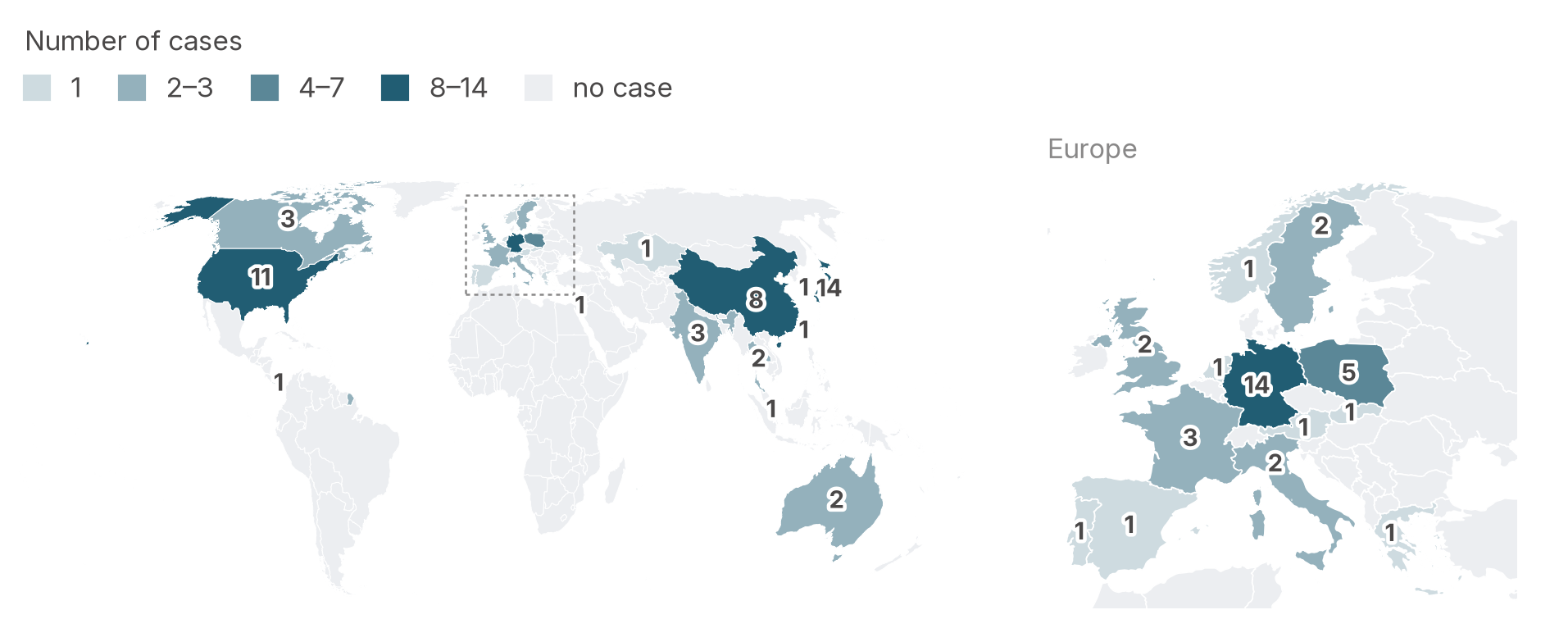
Since 2017, 90 public transport cases that investigated, planned, or announced the use of quantum computing or a quantum-inspired solver have been made public. The number of publications jumped in 2021, and 15 new cases appeared both in 2025 and in the first ten months of 2026. The trials are concentrated in a few countries (Figure 1): Germany and Japan account for 14 cases each, the United States for 11, and China for 8. In Europe, Poland follows Germany with five rail cases. The list contains no case with a Hungarian operator or Hungarian data, although the Wigner Research Centre for Physics in Budapest took part in four of the Polish cases.
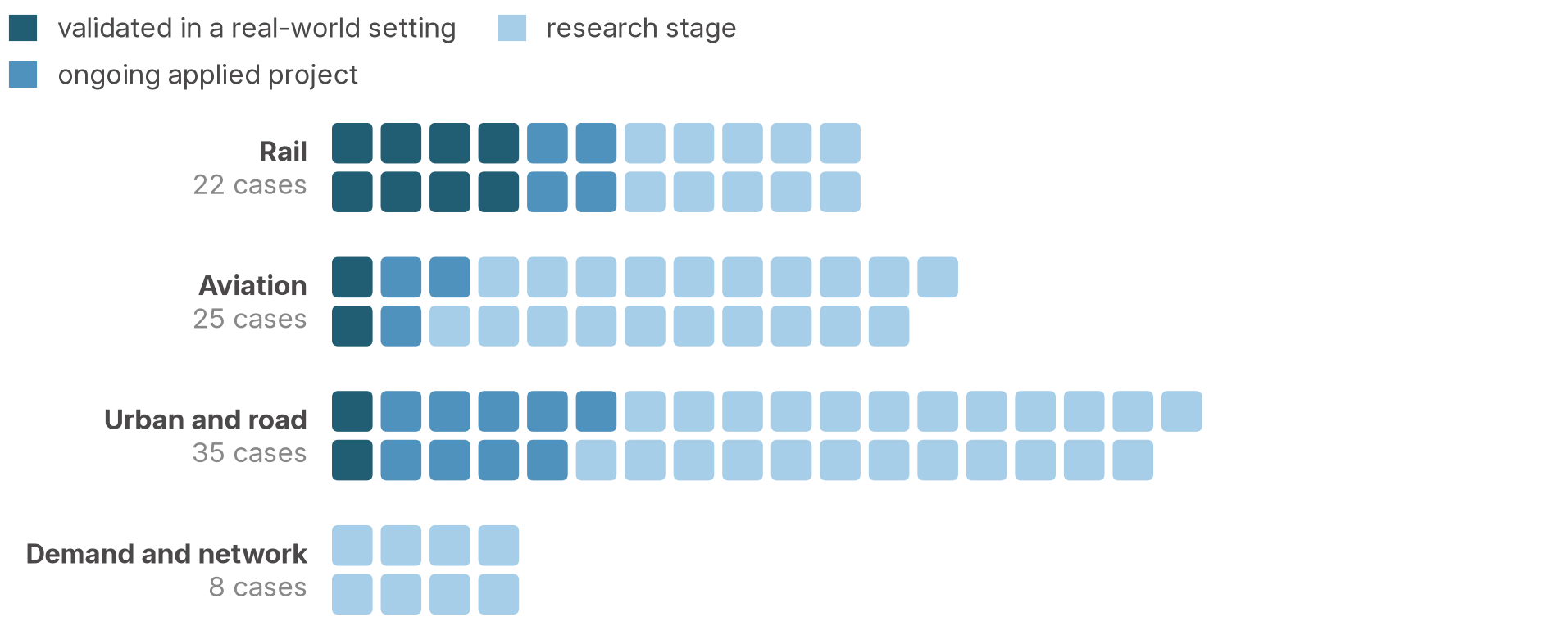
Twelve cases are validated in a real-world setting; under a stricter classification, nine may qualify. A further 16 ongoing applied projects have not yet published results, and the rest are at the research stage. Most of the cases validated in a real-world setting are in rail: they were largely carried out with railway undertakings or infrastructure managers, or on official timetable data. Cases in aviation and urban transport are still mostly research (Figure 2).
The label “quantum” covers several substantially different technologies. D-Wave machines work on the principle of quantum annealing, the quantum counterpart of simulated annealing: the machine searches approximately for the state with the lowest “energy”, that is, the best solution. Quantum-inspired solvers, such as Hitachi’s CMOS annealing or Fujitsu’s Digital Annealer, start from principles of quantum physics but run on conventional semiconductor hardware, and are available today as commercial services. What they share is the input: a binary model of the problem (QUBO), in which every decision is a yes-or-no question and violating a rule worsens the value of the solution as a penalty term.
Comparison with the classical solver
Wherever the quantum approach was also compared with an exact classical solver, the quantum side was never better in solution quality. In rescheduling 27 trains on the Upper Silesian suburban network, D-Wave’s hybrid solver found the optimum on the smaller networks but was 5–72% worse than the classical CPLEX optimum on the larger ones. In one Deutsche Bahn rolling stock trial, constraint programming covered slightly more trips on all but the smallest instance; in another, the difference between a hybrid algorithm running on an IQM machine and a simple greedy algorithm “appears negligible”, according to the authors.
There was a live trial as well. In November 2019, Volkswagen and the Lisbon transport company Carris dispatched nine buses for four days, with D-Wave’s hybrid solver computing the routes within a few seconds. This is still the only public case in which a quantum processor took part in dispatching buses carrying passengers. No classical comparison was made, yet the trial showed that the demand model, the optimization, and the driver application can be linked in a live service.
Two applications have come closest to operation. The Japanese railway company Nankai is building a system based on Hitachi’s quantum-inspired solver to roster the drivers and conductors of several hundred trains a day. According to the companies’ July 2026 announcement, an impact assessment in fiscal year 2025 showed that the months of manual work on crew rostering could be cut to about a week, and the roughly 20 days of work on a monthly rolling stock rotation plan to a few days. The system may go into operation in fiscal year 2027. The gains were measured against manual planning, not against a state-of-the-art mathematical programming solver. The other is Japan Airlines’ maintenance planning tool, presented as quantum computing technology without its method being disclosed, which according to the airline went into operation in March 2026.
A large part of the gain may therefore come from the mathematical formulation of the problem and the automation of planning, as in classical operations research. In 2006, the Dutch railways rebuilt their national timetable and rosters with such methods, and by the company’s estimate the new rosters and growing passenger numbers together brought about EUR 40 million of additional annual profit.
Meanwhile, hardware is developing fast. Manufacturers place the first fault-tolerant machines, which can run long computations with error correction, between 2028 and 2030. A report published by the UK Department for Transport expects fault-tolerant machines offering quantum advantage from about 2035. According to the study, even if the manufacturers’ roadmaps are met, quantum solutions to large transport planning problems may become worth investigating in the early-to-mid 2030s at the earliest. Quantum navigation has reached flight tests: according to DIU and Honeywell, an aircraft of the Embraer 170 airliner type flew for 4 hours 23 minutes without GPS in summer 2026, navigating on magnetic anomalies. Firm target dates apply to post-quantum cryptography, that is, public-key methods (key exchange, signatures) that run on classical computers and resist attacks by quantum computers: the EU roadmap recommends starting the transition by the end of 2026 and moving as many systems as possible by the end of 2035.
Tasks and expertise in Hungary
There is no public information on a transport quantum project in Hungary, but the problems addressed by international trials exist here too, and some of them already run in systems based on classical optimization. The most direct link is BKV, the Budapest transport company. According to papers from 2020 and 2023, its bus vehicle and driver scheduling is supported by a decision support system developed by researchers of the University of Szeged and Óbuda University and integrated into the company’s information system; its current scope of use is not known. The 20 published real bus instances contained 87–811 trips, and three quarters of them were solved to optimality. None of the international cases examined solves integrated vehicle and driver scheduling; the BKV system does, and it provides a strong classical benchmark that many foreign trials lacked.
On the railways, according to the vendor’s announcements, MÁV-START (today MÁV Személyszállítási Zrt.) planned its rolling stock and train drivers with IVU.rail from 2008, and its conductors as well from 2016; the relationship can be confirmed up to 2022, and there is no public information on the system’s current use. OKK Országos Közlekedési Központ Zrt., established in 2026, is responsible for ordering public services, the integrated national clock-face timetable, connections, and the fare system, while Magyar Vonatflotta Zrt. is responsible for the rail rolling stock.
Expertise in quantum modelling is also available in Hungary. Mátyás Koniorczyk of the Wigner Research Centre for Physics is a co-author of the Polish single-track and Upper Silesian rail quantum trials, and the gate assignment trial of Delta Air Lines and IBM was built on a qubit-efficient encoding by Hungarian researchers. The expertise lies with the researchers, the planning systems and data with the operators; there is no public information on a joint project linking the two. The roughly 5,800 buses of the Volán branch of MÁV Személyszállítási Zrt. (2025) are about 40–650 times the number of vehicles in the international trials, and its roughly 10,800 drivers are one to two orders of magnitude more than those studied in rostering trials. Regional city networks are closer to them in scale: in Pécs, the 144 buses of Tüke Busz operate 1,802 trips on a working day.
Where could it start?
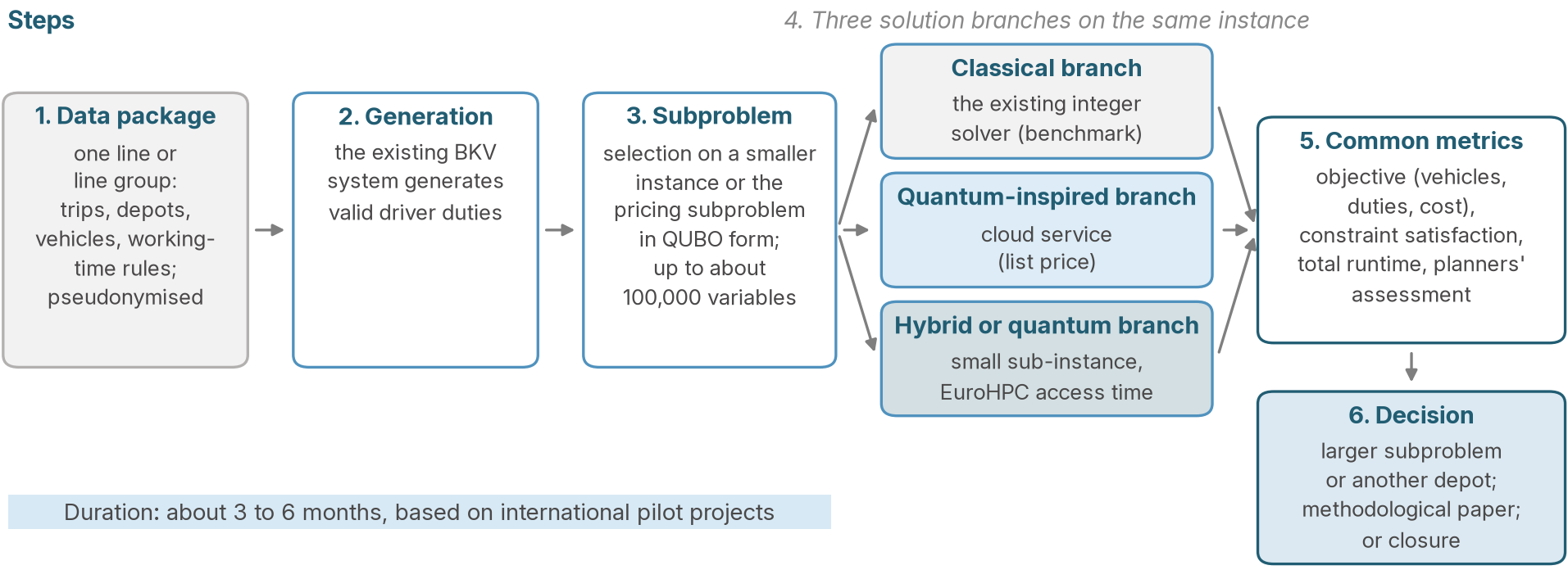
An obvious first step could be a comparative trial built on BKV’s existing system (Figure 3). Even in the published line-group instances, the number of possible driver duties ranged from 6,448 to more than one million, with more than 100,000 in nearly half of them, exceeding the limit of the quantum-inspired solvers available in the cloud; the full BKV problem is larger still. From a pseudonymized data package for one line group, the existing system generates the duties, and a smaller instance of the selection then runs on three branches: a classical solver, a quantum-inspired cloud service, and a hybrid or quantum branch, possibly with the free European computing time available on request since 25 June 2026. The branches are compared on common metrics fixed in advance.
Based on the international comparisons, the quantum-inspired branch is unlikely to produce a better plan than the existing classical solver. On a driver scheduling problem of this size, however, a well-documented comparison would be new internationally, and the model can be rerun on later machines. The same pattern can be followed for rail and Volán rostering at one depot or line group, and the networks of Pécs and Debrecen could serve as test beds in their entirety.
In rail rescheduling, the Polish methodology developed with Hungarian participation could be tested on historical Hungarian data, offline and separately from live traffic control. At the stations, Keleti has 13 and Nyugati 17 platform tracks, the scale of the London Bridge trial; a similar study could start by compiling the track allocation per train, since this is not part of the station operating instructions.
For traffic signals, the progression of the German DLR QI-TraSiCo project from simulation through the laboratory to a test field could serve as a model for a simulation test environment in Budapest. In demand-responsive transport, Budapest route 274, which runs on a route optimized from bookings, and the booking-based services of MVK in Miskolc are small problems similar to the stop-planning trial in the Japanese city of Kawasaki.
In the digital systems of the railways, the question is the transition to post-quantum cryptography. Deployment of the 5G-based FRMCS railway radio system is planned from 2031, subject to funding, so in the layers not fixed by EU rules, how easily the cryptographic components can be replaced may depend on procurement requirements. The mandatory registration and audit under the 2024 Hungarian cybersecurity act could be a natural link for a cryptographic inventory.
None of the international programmes required operators to have their own quantum hardware: the Austrian infrastructure manager takes part in the German DLR programme as an associated partner contributing data, and Copa Airlines of Panama organized a competition based on real operational data.
The first benefit of a pilot in Hungary would probably come from modelling the problems, organizing the data, and the classical comparison, all of which can also pay off in classical planning. If fault-tolerant machines arrive according to the manufacturers’ roadmaps, this work can be used by the organizations whose planning problems are by then available with data, a model, and a measured classical result. If they arrive later, this benefit is not lost.